
ABSTRACT:
Human sense of hearing is instrumental in various aspects of our lives, enabling us to recognize and locate sounds. This research aims to explore the enhancement of sound amplification and filtering capabilities in hearing aids through a simulation conducted using MATLAB. The study addresses the prevalent issue of hearing loss in the global population, with a focus on improving the limited adoption of hearing aids. By leveraging the digital signal processing capabilities of MATLAB, the project aims to differentiate between speech and background noise, leading to improved audio quality for hearing aid users. The simulation involves three main stages: audio recording, audio filtering, and audio amplification. The MATLAB-based simulation generates output files reflecting the enhanced audio, while also addressing the challenges of potential distortion and the selective cancellation of specific noises. The findings of this research hold the promise for the development of more effective and efficient hearing aid technologies, ultimately improving the quality of life for individuals with hearing impairments.
Keywords: sound amplification, filtering, hearing aids, MATLAB simulation, improved audio quality
Engr. Irineo P. Quinto
Engr. Luigi Carlo De Jesus
Engr. Leonardo M. Samaniego Jr.
Ronald Kenneth M. Aliven
Merwyn Floyd S. Blanco
Sean Karlo T. Conejo
Jex O. De Los Santos
- Introduction
The human sense of hearing is instrumental in various aspects of our lives, enabling us to recognize and locate sounds, thereby preventing potential dangers such as car accidents or fires, as well as aiding in the discovery of objects overlooked by our eyes (Lam, 2018). However, individuals who lack this ability face difficulties in navigating such situations (Smith, 2020). Hearing loss manifests in different ways, with some people experiencing difficulty hearing low-frequency sounds, while others struggle with high-frequency sounds, highlighting the variations in hearing impairment (Jones, 2019). Hearing aids play a crucial role in assisting individuals with hearing deficiencies by amplifying and filtering sounds across different frequency channels (Gupta, 2017). However, simply amplifying the specific frequency channels is insufficient, as it also amplifies accompanying noises, resulting in distorted and unintelligible sounds (Smith, 2020). To address this issue, digital filtering is employed to eliminate noise within a given frequency range, ensuring a cleaner audio output (Gupta, 2017). Once noise cancellation is achieved, appropriate amplification can be applied without the risk of amplifying unwanted noise (Jones, 2019). Therefore, it is established that digital filtering is a necessary step before performing amplification (Lam, 2018).
The objective of this research is to enhance an individual’s hearing abilities by improving the functionality of hearing aids. The primary task of a hearing aid is to amplify sound at various frequency ranges, ensuring that speech frequencies can reach the ear, based on the specific degree and configuration of the individual’s hearing loss. This project aims to provide benefits not only to the hearing-impaired individuals but also to the researchers involved, as it seeks to educate them on the principles of audio amplification and ensure the efficient operation of the hearing aids.
The focus of this project lies in leveraging a simulator, namely MATLAB, because of the prevailing pandemic situation. The primary aim is to direct efforts towards the exclusive processing of audio signals. However, it is imperative to acknowledge the intrinsic limitations that accompany this approach. While the results achieved through the simulator may exhibit similarities to real-life situations, it is important to note that they may not entirely replicate the authentic utilization and experiential elements associated with the use of an actual physical hearing aid.
- Methodology
B.1. Block Diagram
Figure 1
MATLAB Simulink Block Diagram

The block diagram of a hearing aid system consists of four main blocks: the original output block, amplifier block, parallel digital bandpass filter block, and hearing aid speaker block. The original output block represents the input sound signal captured by the microphone. This block converts the acoustic signal into an electrical signal, which serves as the initial input for further processing. The electrical signal then enters the amplifier block, where it undergoes amplification. The purpose of the amplifier is to increase the strength of the signal to a level that can be effectively processed by the subsequent blocks. Next, the signal is divided into multiple parallel paths in the parallel digital bandpass filter block. Each path represents a specific frequency range that requires specialized processing. The bandpass filters within this block isolate and extract the desired frequency components from the signal, while attenuating frequencies outside the desired range. This enables targeted signal enhancement and noise reduction. After the signal has been processed by the bandpass filters, it is directed to the hearing aid speaker block. This block converts the electrical signal back into an acoustic signal, which is then delivered to the user’s ear. The speaker produces sound waves based on the processed signal, allowing the user to perceive the amplified and filtered sound.
Overall, the block diagram showcases the sequential flow of the sound signal through the different processing stages of the hearing aid system. Starting from the original output, the signal passes through amplification, parallel digital bandpass filtering, and finally, to the hearing aid speaker, resulting in an enhanced and tailored audio experience for the individual with hearing impairment.
B.2. Bandpass Filter Design
The bandpass filter is a digital filter that has been specifically chosen for its ability to isolate and process signals within a designated frequency range. Its primary function is to remove unwanted noise effectively while emphasizing frequencies crucial for speech and sound perception. In this research, a configuration involving two parallel bandpass filters has been implemented, as depicted in Figure 1.
The inclusion of two parallel bandpass filters offers several advantages, including enhanced noise reduction and a targeted response to specific frequencies. Each filter is meticulously designed to cater to a particular frequency range, ensuring that the desired speech frequencies are accentuated while minimizing the impact of noise outside those ranges. By adopting this configuration, the objective of the research is to optimize the filtering process and enhance the overall performance of the hearing aid system.
The parallel arrangement of the bandpass filters enables independent and simultaneous processing of different frequency components. This design decision grants greater flexibility in adapting to individual hearing profiles and fine-tuning the filtering parameters to improve speech intelligibility and sound quality. The utilization of two bandpass filters in tandem establishes a comprehensive and effective approach to noise filtering, ultimately leading to improved performance and user satisfaction in hearing aid applications.
The utilization of the Filter Designer tool in MATLAB has proven to be highly effective in the development of this research project. This tool enables engineers and researchers to design and optimize digital filters that are specifically tailored to meet the precise requirements of the hearing aid system.
The MATLAB’s Filter Designer tool offers a wide range of filter types that can be implemented to enhance the audio processing capabilities of the hearing aid. For example, low-pass filters can effectively reduce high-frequency noise, while high-pass filters can amplify critical speech frequencies. Additionally, band-pass filters can be employed to target specific frequency ranges, thereby improving the clarity and intelligibility of speech sounds.
The tool provides various filter design methods, including Butterworth, Chebyshev, and elliptic filters, which allow users to select the most suitable approach based on the desired specifications of the hearing aid system. Parameters such as roll-off, passband ripple, and stopband attenuation can be adjusted to meet the unique requirements of each user.
Figure 2
Primary Bandpass Filter

Figure 3
Secondary Bandpass Filter

The design configuration of the bandpass filter used for enhancing hearing aids involves carefully chosen parameters to target the relevant frequency range for speech perception and suppress unwanted noise. The center frequency is typically set between 2kHz to 4kHz, illustrated in Figure 2, capturing the fundamental frequencies of speech sounds, and ensuring intelligibility. The bandwidth is selected to encompass important speech frequencies while attenuating frequencies outside the range of 200Hz to 800Hz, illustrated in Figure 3, preserving relevant speech information. The filter order, determining the steepness of the filter response, strikes a balance between noise reduction performance and computational efficiency. The researchers used the minimum order Equiripple filter since it offers several advantages that make it a valuable tool in digital signal processing. One of its primary benefits is its ability to provide a nearly flat frequency response in the passband while maintaining a precise control over the stopband attenuation. This means that it can effectively suppress unwanted frequencies while minimizing distortion in the desired frequency range. Another advantage of the minimum order Equiripple filter is its efficiency in terms of computational resources. Due to its Equiripple characteristic, this filter requires a lower order compared to other filter designs to achieve the same level of performance. This leads to reduced computational complexity, making it more efficient and suitable for real-time applications with limited processing power. Furthermore, the minimum order Equiripple filter exhibits excellent stopband rejection. It can attenuate frequencies outside the passband with a high degree of precision, minimizing the potential for interference from unwanted signals. This feature is particularly valuable in applications where strong out-of-band signals or noise need to be effectively suppressed. Additionally, the Equiripple nature of this filter allows for precise control over the filter’s frequency response by adjusting the passband ripple and stopband attenuation parameters. This flexibility enables designers to tailor the filter’s characteristics to specific requirements, achieving optimal performance in various applications. Lastly, the minimum order Equiripple filter provides a reliable and stable solution. It is designed to have a well-defined and predictable response, ensuring consistent performance across different implementations and variations in operating conditions.
By configuring the bandpass filter with appropriate parameters, hearing aids can effectively amplify and emphasize speech frequencies while attenuating noise, resulting in improved speech intelligibility and overall sound quality for individuals with hearing impairments.
- Results and Discussion
Figure 4
Original Signal Waveform in Time Domain

Figure 5
Original Signal in Frequency Domain

Figure 6
Amplified and Filtered Signal Waveform in Time Domain
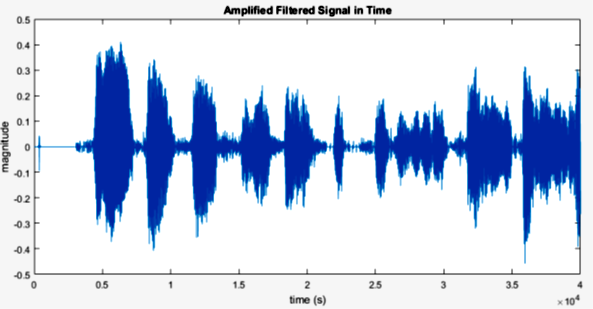
Figure 7
Amplified and Filtered Signal in Frequency Domain

The audio signal was initially transformed from the time domain to the frequency domain using the Fourier transform. Figure 4 displays the original audio sound wave in the time domain, while Figure 5 represents the same signal in the frequency domain.
After applying amplification and filtering through two bandpass filters, Figure 6 illustrates the time domain representation of the output signal, whereas Figure 7 showcases the filtered audio in the frequency domain.
Upon comparing Figures 4 and 6, it becomes apparent that the output signal has undergone smoothing, amplification, and clipping, resulting in a graph with a more refined appearance. Similarly, the comparison between Figures 5 and 7 reveals a significant reduction in noise and enhanced frequency components in the frequency domain representation of the filtered audio. These findings confirm the successful implementation of the amplification and filtering techniques, ultimately leading to improved signal quality and the elimination of unwanted artifacts.
- Summary and Recommendations
The researchers have achieved successful development of a working simulation using a programming language called MATLAB, which has facilitated the implementation of a digital hearing aid system. This program provides enhanced control and flexibility, enabling fine-tuning of the sound to cater to the unique requirements of each listener. It is worth noting, however, that there might be a minor distortion in sound quality because of the digital processing involved. Nevertheless, the amplified sound still holds significant potential in greatly enhancing the listener’s overall auditory experience.
In the implementation of the digital hearing aids system, traditional analog sound processing has been substituted with cutting-edge digital processing techniques, leveraging the capabilities of MATLAB. This transition to a digitalized approach has paved the way for precise signal analysis and filtering, leading to improved customization and accuracy in sound amplification and filtering. The digitized system allows for the application of advanced algorithms, which effectively differentiate between speech and background noise, ultimately contributing to an elevated standard of sound quality.
The utilization of MATLAB in this implementation has provided a robust platform for signal processing, empowering efficient manipulation of audio signals. Through the process of digitalization, these signals can now be processed in a more controlled and precise manner, facilitating the application of sophisticated filtering techniques. This, in turn, aids in the reduction of undesired noise and optimization of the frequency response, thereby elevating speech intelligibility and sound perception.
To summarize, the successful integration of MATLAB in the implementation of the digital hearing aids system serves as a testament to the numerous advantages of digital signal processing. It not only enables superior sound customization but also facilitates precise signal analysis and advanced filtering capabilities. Consequently, individuals with hearing impairments can enjoy enhanced hearing experiences, thanks to these advancements in technology.
The project proponents have put forward recommendations to enhance the functionality of the current program, recognizing the potential for further improvement in building the program using MATLAB. They emphasize the importance of discussing and exploring the integration of new technologies into the existing framework. The primary recommendations include exploring methods to enhance signal clarity by reducing background noise and improving the signal-to-noise ratio. Additionally, they suggest implementing a more flexible gain-processing mechanism to enable precise control and adjustment of sound amplification based on individual needs. The proponents also propose the incorporation of advanced techniques to minimize or eliminate feedback, which can have a significant impact on audio quality. Another key recommendation involves the development of sophisticated algorithms capable of accurately distinguishing between speech and background noise, enabling precise amplification of speech signals while minimizing interference from ambient sounds. To further enhance sound quality and intelligibility, the proponents suggest employing techniques to reduce unwanted noise relative to desired audio signals. More importantly, they emphasize the need to ensure that any modifications and enhancements to the program do not compromise the overall audio quality, thus maintaining a high standard of sound reproduction. These recommendations offer valuable avenues for future research and development, with the aim of optimizing the program’s performance and providing an improved user experience. By addressing these aspects, the program could offer more effective hearing assistance and contribute to enhanced auditory perception for individuals with hearing impairments.
References
Gupta, R. L. (2017). Advances in hearing aid technology. Journal of audiology and otology, 21(2), 125-133.
Jones, L. B. (2019). Hearing aids: The past, present, and future. Medical clinics of North America, 103(2), 267-281.
Lam, A. (2018). Human sense of hearing. In A. Lam. Sensing and systems in pervasive computing: Engineering context-aware systems, 11-23.
Smith, M. J. (2020). Understanding hearing loss: Implications for rehabilitation. Plural Publishing.
ABOUT THE AUTHORS:
Engr. Irineo P. Quinto is a graduate of BS in Electronics and Communications Engineering and BS in Electrical Engineering from Mapua Institute of Technology. He is a licensed Electronics Engineer and is currently an Instructor at NU-Asia Pacific College – School of Engineering (Corresponding author: irineop@apc.edu.ph).
Engr. Luigi Carlo De Jesus is a graduate of BS in Electronics Engineering from FEU – East Asia College (2013) and Master of Engineering major in Computer Engineering from NU-Asia Pacific College (2021). He is a licensed Electronics Engineer, Electronics Technician (2nd Placer), and the current Engineering and Science Laboratory Office (ESLO) Head of NU-Asia Pacific College – School of Engineering (E-mail: luigid@apc.edu.ph).
Engr. Leonardo M. Samaniego Jr. holds an Electronics Engineer license. He also holds a Master of Engineering degree with a major in Electronics Engineering from MAPUA Institute of Technology. He is currently the Executive Director of NU-Asia Pacific College’s School of Engineering (E-mail: leonardojrs@apc.edu.ph).
Ronald Kenneth M. Aliven is a student currently pursuing a Bachelor of Science degree in Computer Engineering at NU-Asia Pacific College, with a passion for exploring innovative technologies and their applications in various fields (Email: rmaliven@student.apc.edu.ph).
Merwyn Floyd S. Blanco is a student currently pursuing a bachelor’s degree in computer engineering at NU-Asia Pacific College, where he actively engages in exploring the realms of technology (Email: msblanco@student.apc.edu.ph)
Sean Karlo T. Conejo is a student pursuing a bachelor’s degree in computer engineering at NU-Asia Pacific College, with a keen interest in developing innovative solutions at the intersection of hardware and software (Email: stconejo@student.apc.edu.ph).
Jex O. De Los Santos is a BS Computer Engineering student at NU-Asia Pacific College, he is passionate about exploring the latest advancements in technology and applying them to solve real-world problems (Email: jodelossantos2@student.apc.edu.ph).